The post Master in Food Safety and Quality Assurance appeared first on University of Science and Technology of Hanoi.
]]>1. OVERVIEW
Food safety has been and continues to be a pressing public health issue worldwide. In Vietnam, concerns related to agricultural product quality control and food safety assurance have received sustained attention from central to local authorities and are regularly discussed in scientific conferences and media outlets. Most recently, Directive No. 17-CT/TW dated 21 October 2022 of the Party Central Committee’s Secretariat on strengthening food security and safety in the new context called for the development of high-quality human resources in food science and technology, particularly in inspection, management, quality assurance, and food safety and security. In response, the Goodd889 cá cược trực tuyến Master’s programme in Food Quality Assurance and Food Safety (FSQA) has been designed to provide solid academic and professional knowledge, addressing current pressing issues in food safety and security, with a high level of practical training and internships in laboratories, research centres, institutes, and professional settings.
In the context of globalisation and digital transformation, food safety has become a critical factor for all food production and distribution enterprises. In addition to quality control and food hygiene, the programme places particular emphasis on equipping students with competencies in product traceability – a mandatory requirement under current legislation for high-risk goods such as food. The FSQA programme benefits from the direct teaching involvement of experts from the National Institute for Food Control (NIFC) and the National Barcode Centre, two leading institutions in Vietnam in the fields of food safety testing and product traceability, together with ESIAB at Bretagne INP (France), a strategic international partner bringing expertise in sustainable food systems and advanced technologies in food quality assurance, thus ensuring the practical relevance and currency of the programme.
PROGRAMME HIGHLIGHTS
- The programme follows the Bologna Process framework, using the European Qualifications Framework (EQF) and the European Credit Transfer and Accumulation System (ECTS), enabling recognition of learning outcomes in over 45 countries across Europe and worldwide, and facilitating transfer to or continuation in other international programmes within the same system.
- Advanced learner-centred teaching methodology with a strong focus on practical and field-based sessions to maximise student potential.
- The programme is taught entirely in English by professors from leading universities and research institutes in Vietnam, France, Italy, and beyond.
- Rich professional experience through two internship placements, both domestic and international, totalling nine months.
- High opportunity to receive full scholarships and living allowances from Goodd889 cá cược trực tuyến.
- High opportunity to receive full scholarships for internships in France and other European countries.
- High opportunity to receive doctoral scholarships in France for talented Goodd889 cá cược trực tuyến students.
- Wide employment opportunities upon graduation in government agencies, NGOs, research institutes, universities, and Vietnamese and international companies.
2. PROGRAM
2.1. Programme Objectives
The Master’s programme in Food Quality Assurance and Food Safety (FSQA) is designed to train a generation of food professionals with systems thinking, advanced analytical competencies, and the ability to adapt to international professional environments in the fields of food quality assurance, food safety, and food security.
Graduates are equipped to take on high-level specialist roles within government food safety management systems, food testing and risk assessment organisations, domestic and international food companies and corporations, as well as research and development institutions. The programme also provides a strong foundation for students wishing to pursue doctoral studies and academic careers in Vietnam and abroad.
The FSQA training approach goes beyond traditional technical knowledge to address the global trends reshaping the food industry: the development of sustainable food systems, ensuring food security in the context of climate change, applying digital technologies and Industry 4.0 in supply chain management, and meeting increasingly high demands for transparency and environmental responsibility in food production.
2.2. Programme Structure
The FSQA Master’s programme comprises 25 modules (equivalent to 120 ECTS, over four semesters), taught entirely in English. Over 40% of modules are delivered by international lecturers from France, Italy, Taiwan, Thailand, and partner countries. The programme is built around two main knowledge pillars: Food Quality Assurance and Food Safety Assurance, while integrating interdisciplinary themes reflecting global trends in the food industry.
One of the distinctive strengths of FSQA is its specialised curriculum, designed to directly address real-world labour market needs:
On quality control and management, students receive in-depth training in advanced food quality analysis and testing methods, food quality and safety management systems, Food Safety Audit and Risk Assessment in Food Safety — core competencies in both public sector management and modern corporate environments.
On traceability and supply chain management, the programme dedicates a specialised module to Traceability and Logistics Management in Food Supply Chain, combined with Food Supply Chain Quality Management, equipping students with the competency to operate and oversee the full journey of food products from production to the consumer.
On sustainable development and Industry 4.0, the programme pioneers teaching on carbon footprint and environmental impact mitigation in food production (Food Footprint), targeting net zero in the agri-food supply chain; the application of green technologies and Industry 4.0 in sustainable agri-food systems; and circular economy linked to sustainable food systems. These modules are developed with the academic contribution of ESIAB – Bretagne INP (France), a renowned food science and technology institution in France.
On food security and emerging trends, students are updated on Global Food Safety and Security Challenges, new trends in food research and innovation, and sustainable agriculture – reflecting FSQA’s commitment to training professionals who not only meet current needs but are ready to lead future change.
Two intensive internship placements totalling nine months at research institutes, laboratories, and food companies in Vietnam or abroad complete the training journey, allowing students to build genuine professional experience before graduation.
CURRICULUM
| SEMESTER 1 | ||
| Module code | Modules | ECTS |
| FSS01/C1 | English Master 1 (Tiếng Anh Thạc sỹ 1) | 2.5 |
| FSS02/FRM1 | French Master 1 (Tiếng Pháp Thạc sỹ 1) | 1 |
| FSS03/MMS1.001 | Quản lý Gôd88 tỷ lệ cược cao (Science and Technology Management) | 1.5 |
| FSS07/BP11 | Hóa sinh và enzyme học (Biochemistry and Enzymology) | 5 |
| FSS08/BP15 | Thống kê và thử nghiệm sinh học (Statistics and biological experimentation) | 4 |
| FSS09 | Các phương pháp tiên tiến trong kiểm soát vi sinh thực phẩm (Advanced techniques for microbiological control in food) | 4 |
| FSS10 | Goodd889 sảnh cược đa dạng thực phẩm nâng cao (Advanced Food Chemistry) | 4 |
| FSS11 | Quản lý chất lượng và an toàn thực phẩm (Food Quality and Safety Management) | 4 |
| FSS12 | Thách thức an toàn và an ninh thực phẩm toàn cầu (Global Food Safety and Security Challenges) | 4 |
| SEMESTER 2 | ||
| FSS13 | Các kỹ thuật phân tích chất ô nhiễm và độc tố trong Kiểm soát chất lượng Thực phẩm (Modern techniques for Contaminants and toxins analysis in Food Quality Control) | 4 |
| FSS14 | Đánh giá nguy cơ an toàn thực phẩm (Risk Assessment in Food Safety) | 4 |
| FSS15 | Thanh tra an toàn thực phẩm (Food Safety Audit) | 4 |
| FSS16 | Truy xuất nguồn gốc và quản lý giao vận trong chuỗi cung ứng thực phẩm (Traceability and Logistics Management in Food Supply Chain) | 4 |
| FSS25 | Thực tập M1 (M1 internship) | 10 |
| Elective (Choose 1 module) | ||
| FSS21 | Quá trình và thiết bị trong công nghệ thực phẩm nâng cao (Advanced Process and Equipment in Food Technology) | 4 |
| FSS23 | Nông nghiệp bền vững (Sustainable agriculture) | 4 |
| SEMESTER 3 | ||
| FS04/FRM2 | French Master 2 (Tiếng Pháp Thạc sỹ 2) | 2 |
| FS05/MMS2.001 | Quản lý đổi mới sáng tạo Gôd88 tỷ lệ cược cao (Science and Technology Innovation Management) | 1.5 |
| FS06/MMS2.001 | Phương pháp Goo88d.com link không bị chặn Gôd88 tỷ lệ cược cao (Research method in Science and Technology studies) | 1.5 |
| FSS17 | Ứng dụng công nghệ xanh và Công nghiệp 4.0 trong hệ thống nông nghiệp thực phẩm bền vững (Application of green and Industry 4.0 Technologies in sustainable agri-food systems) | 4 |
| FSS18 | Dấu chân thực phẩm: Giảm thiểu tác động môi trường trong sản xuất nông nghiệp-thực phẩm bền vững (Food Footprint: Mitigation of environmental impacts in sustainable agri-food production) | 4 |
| FS19 | Kinh tế tuần hoàn và hệ thống thực phẩm bền vững (Circlular economy and the sustainable food system) | 4 |
| FSS20 | Quản lý chất lượng chuỗi cung ứng thực phẩm (Food Supply Chain Quality Management) | 4 |
| FSS21 | Workshop:Career orientation in food quality assurance, safety and security (Workshop: định hướng nghề nghiệp trong lĩnh vực đảm bảo chất lượng, an ninh và an toàn thực phẩm) | 4 |
| Elective (Choose 1 module) | ||
| FSS22 | Nâng cao giá trị của phế phẩm và phụ phẩm nông nghiệp-thực phẩm (Valorization of agri-food wastes and by-products) | 5 |
| FSS23 | Xu hướng mới trong Goo88d.com link không bị chặn và đổi mới thực phẩm (New trends in food research and innovation) | 5 |
| SEMESTER 4 | ||
| FSS26 | Thực tập M2 (M2 internship) |
30 |
2.3. Programme Learning Outcomes
– PLO1: Apply fundamental scientific knowledge and disciplinary foundations to support professional activities, academic development, and scientific research.
– PLO2: Apply specialised knowledge in food quality assurance and food safety to professional practice; assess food safety risks; and design comprehensive food quality and safety management systems, including risk assessment and food safety auditing.
– PLO3: Develop and evaluate advanced analytical and testing methods for agricultural and food quality, and design quality control processes tailored to specific product requirements and food safety regulations.
– PLO4: Evaluate the effectiveness of food supply chain quality management systems and design optimisation solutions, integrating advanced traceability technologies and sustainable logistics management strategies to enhance food safety and quality.
– PLO5: Synthesise strategies to strengthen food security, propose solutions to valorise agri-food wastes and by-products, and mitigate environmental impacts in sustainable agri-food production, while evaluating the effectiveness of these strategies in the context of global food safety and security challenges.
– PLO6: Apply green technologies and Industry 4.0 in the development and management of sustainable agri-food systems to enhance production efficiency and reduce environmental impact.
– PLO7: Analyse and synthesise emerging trends in food research and innovation, and design and implement scientific research projects in food quality assurance, food safety, and food security.
– PLO8: Demonstrate scientific ethics, teamwork skills, effective communication, and persuasive presentation in research and applied work in food quality assurance, safety, and security.
– PLO9: Apply English language skills at Level 4/6 of the Vietnamese Foreign Language Proficiency Framework to read specialised literature, write scientific reports, and communicate effectively in professional activities related to food quality assurance, safety, and security.
2.4. Career Opportunities
Graduates of the FSQA Master’s programme have wide-ranging employment opportunities across multiple sectors:
– In government food safety management agencies, graduates can serve as policy and regulatory specialists, food safety inspectors, food supply chain and traceability experts within relevant Ministries and agencies, or specialists in food security strategy and sustainable food system development.
– At research institutes and testing centres, graduates can conduct food safety analyses and testing, and contribute to the development of national technical food standards and regulations.
– In the private sector, graduates are equipped to take on roles as food quality management and food safety assurance specialists in domestic and international food companies and corporations.
– At international organisations and NGOs, graduates can work on projects related to food safety and nutrition, food security, sustainable food value chain development, and food waste reduction.
In addition, the programme provides a strong foundation for graduates wishing to pursue doctoral studies and academic careers as lecturers or researchers at universities and research institutes in Vietnam and abroad.
3. INTERNSHIPS
Students have the opportunity to undertake internships at Goodd889 cá cược trực tuyến’s partner institutions in France and worldwide, including:
- INP Bretagne
- Université Lyon 1
- Université de Lille
- Université de Montpellier
- Institut Agro Dijon
- University of Trento, Italy
- Università Cattolica del Sacro Cuore, Italy
- National Yang Ming Chiao Tung University, Taiwan
- Prince of Songkla University, Thailand
Students will also have the opportunity to undertake internships at specialist research institutes and centres including the National Institute for Food Control (NIFC), the National Barcode Centre, the Centre for International Cooperation in Agronomic Research for Development (CIRAD, France), the Centre for Food, Agriculture and Environment (Italy), and the Institute of Food Safety, Risk Assessment and Health (Taiwan).
4. ADMISSION REQUIREMENTS
– Applicants holding a Bachelor’s degree in Food Science and Technology, Food Engineering, Post-harvest Technology, Food Quality Assurance and Safety, or Seafood Processing Technology will be considered for direct admission without prerequisite coursework.
– Applicants holding a Bachelor’s degree in other fields such as biology, pharmacy, chemistry, or environmental science will be assessed individually by the admissions committee, which will determine any required prerequisite or bridging courses.
– Proof of English language proficiency is required (TOEFL, IELTS, or equivalent certificate).
5. CONTACT
For more information, please contact
– About the training program:
Department of Life Sciences (LS)
Tel: (+84-24) 3212 1576
Email: [email protected]
Add: Room 307, 3rd floor, A21 building, University of Science and Technology of Hanoi
– About Admission:
Department of Admissions and Communications (DAC)
Tel: (+84-24) 3791 7748
Email: [email protected]
Add: Room 102, 1st floor, A21 building, University of Science and Technology of Hanoi

The post Master in Food Safety and Quality Assurance appeared first on University of Science and Technology of Hanoi.
]]>The post Master in Medical biotechnology – Plant biotechnology – Pharmacology appeared first on University of Science and Technology of Hanoi.
]]>1. OVERVIEW
Goodd889 cá cược trực tuyến proposes an international Master’s Degree in Medical biotechnology – Plant biotechnology – Pharmacology, of 19 teaching units (equivalent to 120 ECTS) taught in English. More than 60% of module courses are taught by foreign lecturers. The Master’s program was accredited by the French Ministry of Higher Education and Research in October 2016. The program is characterized by academic and practical courses that initiate the student to the top knowledge and cutting-edge technologies in Biotechnology and Pharmacology. Two internships in public or private research and development laboratories, in Vietnam or abroad, allow the student to get first professional experiences to conduct and report on a scientific research project. In addition, students have equipped knowledge in law, economy, and management to be familiar with the international regulations and practices operative in international and Vietnamese companies.
Tracks: Plant Biotechnology, Biomedicine, Drug development
Why should you choose this course
- International Master Double-diploma granted by French Universities and Goodd889 cá cược trực tuyến
- The curriculum is updated to align with global technology trends.
- Advanced teaching methods via laboratory works and practical courses
- Lectures delivered in English by professors from French leading universities
- Working experience through a six-month internship in Vietnam and abroad
- High possibility to get full scholarship and fellowship from Goodd889 cá cược trực tuyến
- High possibility to get a full scholarship for internship in France
- High possibility to apply for French Ph.D. scholarship for best Goodd889 cá cược trực tuyến students
- Great career opportunities in Vietnam and abroad after graduation
List of co-accredited universities with which Goodd889 cá cược trực tuyến is associated
2. PROGRAM
2.1. Curriculum
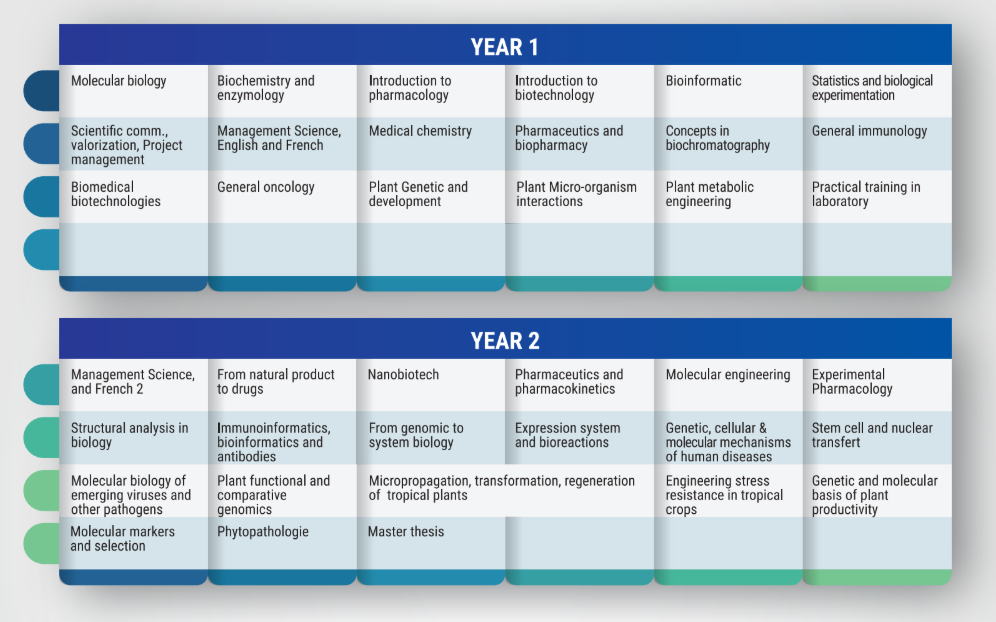
2.2. Career opportunities
Graduates have numerous career opportunities in biotechnology, biomedical sciences, and pharmaceuticals. They can work in healthcare facilities, laboratories, quality control for pharmaceuticals, food, and biological products, research institutes, universities, or pursue a PhD. Career paths also include drug research and development, quality assurance, and bioinformatics in pharmaceutical and biotech companies. Additionally, graduates can work in agricultural and environmental biotechnology, regenerative medicine, biomedical diagnostics, scientific management, or even start their own businesses. With an internationally recognized education, they can pursue careers in Vietnam, non-governmental organizations, or various countries worldwide.
3. ADMISSION REQUIREMENTS
Vietnamese citizens and foreigners who hold a Bachelor’s degree in relevant fields and meet one of the following language proficiency requirements for admission:
- Obtaining a language proficiency certificate equivalent to level 4* promulgated in the six-level foreign language proficiency framework of Vietnam
- Obtaining a Bachelor’s degree or a postgraduate qualification in English, or in a recognized training program using English as the main language of instruction,
- Having completed Goodd889 cá cược trực tuyến’s English Intensive course.
Citizens belonging to one of the following categories may be considered by the Admissions Committee to be admitted to a second year Master’s program (M2):
- Candidates who have completed the first year of Master’s program (M1) at local or international foreign universities following the Bologna process or have completed 240 ECTS-European Credit Transfer and Accumulation System, and pass the application review process.
- Candidates who have obtained Engineering degrees from institutions accredited by CTI/PFIEV, or from other educational institutions recognized by authorities, and must be approved by the Admissions Committee.
- Candidates who have obtained a four-year Bachelor’s degree ranked Good or higher, recognized by the French government as equivalent to the first 60 ECTS after obtaining a Bachelor degree, can pass the application review process, and must be approved by the Admissions Committee with the decision of Rector.
* Conversion table of Foreign Language Degrees and Certificates equivalent to Level 4 of the six-level Foreign Language proficiency framework used in Vietnam for admissions and academic training at Master’s level.
|
No. |
Certificate/Degree |
Level/Score Level 4 equivalent |
| 1 | TOEFL iBT | 46 – 93 |
| 2 | IELTS | 5.5 – 6.5 |
| 3 | Cambridge Assessment English | B2 First/B2 Business Vantage/ Linguaskill.
Score 160 – 179 |
| 4 | TOEIC
(4 skills) |
Listening: 400 – 489
Reading: 385 – 454 Speaking: 160 – 179 Writing: 150 – 179 |
| 5 | Aptis Esol | B2 |
Admissions method: Application dossier assessment and interview.
4. CONTACT
– About the training program:
Department of Life Sciences (LS)
Tel: (+84-24) 3212 1576
Email: [email protected]
Add: Room 307, 3rd floor, A21 building, University of Science and Technology of Hanoi
– About Admission:
Department of Admissions and Communications (DAC)
Tel: (+84-24) 3791 7748
Email: [email protected]
Add: Room 102, 1st floor, A21 building, University of Science and Technology of Hanoi
The post Master in Medical biotechnology – Plant biotechnology – Pharmacology appeared first on University of Science and Technology of Hanoi.
]]>